
Find It Right The First Time!
Subsurface Utility Engineering
Subsurface Utility Engineering (SUE) is the process of collecting and assessing information on the subsurface utilities beneath a proposed excavation site.
If you’re carrying out excavation work, there’s a risk you’ll make contact with underground utilities. The SUE process helps you accurately locate the utilities and put measures in place that avoid the risks.
Why Should I Choose Geoscope To Complete SUE Process
We pride ourselves with highly-skilled technicians can accurately complete subsurface utility engineering processes even on complex sites.
We Specialize in completing these types of proccesses with the highest standards reducing your risk of utility strikes, along with our extensive knowledge and reputable operators
Working with us will reduce unexpected delays from possible damages and reduces design and construction costs.
Who Needs The SUE Process?
Anyone who is planning to break the ground has a responsibility to follow the SUE process. If you are managing the excavation site, then you have a legal obligation to locate any underground utilities before beginning any ground breaking activity.
How Do I Begin The SUE Process?
Your starting point should be to get hold of the plans relevant to your dig site from the asset owners.
With the myriad of utility owners, it can seem like a daunting prospect to get in touch with them all to identify if any of their underground services are located on your site. Luckily, with the free Dial Before You Dig (DBYD) service, most of the legwork is done for you.
You simply submit your request to DBYD via their website or by calling 1100 (toll-free, during business hours) and let them know the details of your planned project. We prefer the DBYD mobile app that can use your location settings to pinpoint where you are and highlight your dig site from there. They forward the details to the utility owners for you, and you will receive all the relevant plans via email. Usually, this all happens within 48 hours.
Once you have the plans, get someone competent and experienced to read them and confirm if there are any known utilities located on or around your excavation site. The asset owners will also provide any other relevant information or instructions so that you understand what you need to do. If in doubt, you should always contact the asset owners.
Along with the plans, you will also receive any relevant instructions, including the minimum safe approach distance. Each asset owner has a different minimum approach distance requirement, depending on the type of excavation work you are planning and the location and type of underground pipe or cable.
The control measures the asset owners request can vary greatly depending on the risk to the asset and the local community. They may even require an asset owner to have a representative on-site to supervise the excavation activity. Large, high-pressure gas pipelines tend to have the strictest exclusion zones of anywhere between 2m and 20m upwards.
If you have any questions or concerns about the instructions provided, you should contact the asset owner directly to discuss them.
The DBYD part of the SUE process is fairly straightforward, but your responsibilities don’t stop here. Getting the DBYD plans is just the first step. The next step is to use locating devices to confirm the locations of the underground services.
Why Is Underground Utility Location Necessary?
Anyone who is planning to break the ground has a responsibility to follow the SUE process. If you are managing the excavation site, then you have a legal obligation to locate any underground utilities before beginning any ground breaking activity.
How Does GPR Work?
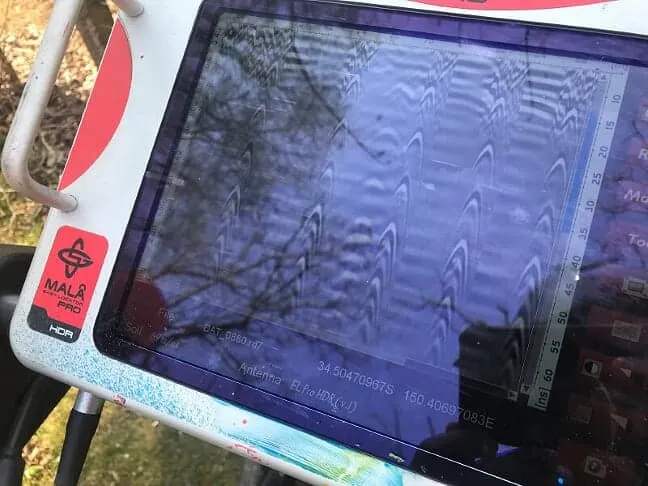
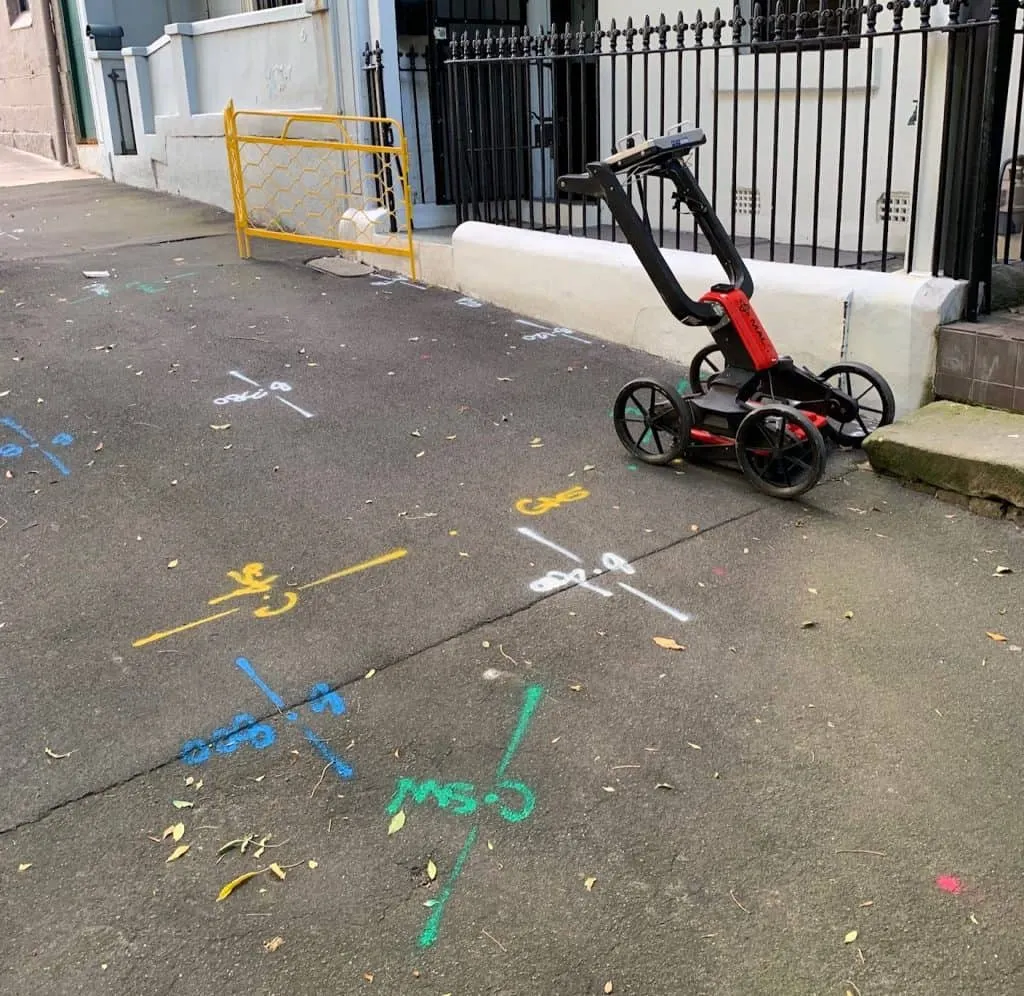
When the area is scanned using the GPR locating device, it transmits electromagnetic radar into the ground. These signals reflect off any subsurface materials have a differing dielectric constant and are communicated back to the receiver where they are stored.
These radar waves are projected into the soil in a cone-like shape from under the antenna, where if they encounter underground structures, they reflect the energy back. This energy comes back at a different wavelength depending on the material and type of structure – which is how the different utilities can be identified. It also measures the depth and location of the target by analysing the time taken for the radar signal to be returned.
How Does Electromagnetic Locating work?
Electromagnetic locating devices have a transmitter and a receiver. The transmitter sends a signal that reflects back to the receiver. It can pick up the signal as long as the pipe or cable material is metallic. It doesn’t work with non-metallic pipes and cables as they don’t conduct the signal back to the receiver unless there is a trace wire that is laid in the trench and available at the riser.
The Electromagnetic frequency of the signal can be adjusted to find specific utilities that match that frequency. Adjusting the frequency allows you to pinpoint the target and separate it from other, surrounding pipes and cables.
There Are Several Levels Of Quality When It Comes To Subsurface Utility Engineering
According to the Australian Standard AS 5488, these are:
Quality Level D
The lowest level is relying on the DBYD records. Unfortunately, the DBYD data may not provide a complete or entirely accurate picture of any underground services onsite. Not all assets owners are registered with DBYD, and not all plans are completely up to date. This location level is to be treated as a guide of the presence of underground services only.
Quality Level C
To achieve this level, you’ll need to align the DBYD plans to surface level features. It gives an additional level of confidence, and a survey of the surface level features can help you identify any underground utilities that may not be on the DBYD plans. Geoscope also mark high quality GPR signals found in linear arrangement as a QL-C
Quality Level B
This level is achieved by completing a full location survey with depth detail, normally by using electromagnetic locating devices. This gives a fairly high level of confidence that the utilities on or near the site have been located in order for control measures to be implemented.
Quality Level A
This is the highest possible level, which requires the utilities to be physically sighted by potholing. This is the ultimate level of confidence, as you can visually confirm the location and alignment and height or depth of the utilities.
At Geoscope, we highly recommend achieving Quality Level A as part of the SUE process, to drastically minimise your risk of a costly accidental utility strike. A comprehensive utility survey is certainly worth the reasonable amount of time and money it costs. Having all the subsurface utility information accurately documented before you begin any excavation work both ensures your duty of care is fulfilled and gives you peace of mind.
There Are Several Ways To Induce The Signal Onto The Line, But Normally You Would Either Connect To The Target Conductive Pipe Or Use An Induction Clamp Around The Cable To Conduct The Signal.
When using the induction clamp, it’s important to ensure that the clamp is fully closed around the target cable.
However, these methods need access to a connection point like a pit or electrical switchboard etc. If there’s no connection point access, then the transmitter can be laid over the line and the signal induced into the ground. This is a slightly less accurate option and depth readings can be inadequate although with potholing and NDD verification, we can achieve some good results.
Electromagnetic locating devices are great tools for finding pipes made of conductive materials, but we don’t recommend that you use these devices alone for your utility survey. Ideally, you should use both Ground Penetrating Radar and electromagnetic methods together, as it allows for a very high accuracy rate of underground service location.
How Much Does Completing The SUE Process Cost?
This is a tricky question to answer, as it will depend on the size and complexity of the site and the planned excavation works as well as the types and locations of any underground utilities on the site.
When discussing with clients the cost of completing the subsurface utility engineering process for them, we ask a number of questions. These help us understand the scope of the project and how much of the process we will be completing for them. A simple and straightforward Quality Location QL-B site visit can cost as little as $330, with more complex sites involving potholing and survey and mapping can range from $10,000 into the hundreds of 1000s.
The type and material of the pipes and cables will have an impact on the cost of locating and mapping them. For example, easily locating a non-metallic fibre-optic cable which we need install a metallic trace wire from a traceable push rod through the line. In contrast, if it’s a copper water service, we can locate the pipe itself as it’s made of conductive materials.
Some pipes and cables will take longer than others to locate and have different levels of accuracies due to methods used to locate them. The more complex the site and the more utilities, the time it takes to accurately locate the pipes and cables.
Different services have different methodology when searching for them. Some are easier than others though where there is a will, there is a way.
Of course, employing experts to complete the SUE process is almost always faster and more cost effective than trying to do it yourself. Using site staff who may have only minimal knowledge and experience can end up putting your project at risk.
Accurate locating underground utilities can keep you and your workers safe, and also reduce the financial risks associated with a utility strike.
Copyright 2022 Geoscope Utiliy Detection Services
This site is not a part of the YouTube, Google or Facebook website; Google Inc or Facebook Inc. Additionally, This site is NOT endorsed by YouTube, Google or Facebook in any way. FACEBOOK is a trademark of FACEBOOK, Inc. YOUTUBE is a trademark of GOOGLE In0